Don’t Get Pressed: Top Screen Printing Machines for Every Budget
Why Choosing the Right Screen Printing Press Matters
A screen printing press is the backbone of any apparel decoration business, whether you’re printing shirts in your garage or running a high-volume production facility. The right press can make the difference between struggling to fill orders and scaling your business efficiently.
Quick Guide to Screen Printing Presses:
- Manual presses are ideal for startups and small batches (under $1,000 – $5,000), offering hands-on control with 1-8 colors and 1-8 stations
- Automatic presses are built for high-volume shops ($10,000+), achieving 1,000+ prints per hour with consistent quality
- Key features to consider: number of colors (print heads), number of stations (pallets), micro-registration capability, and build quality
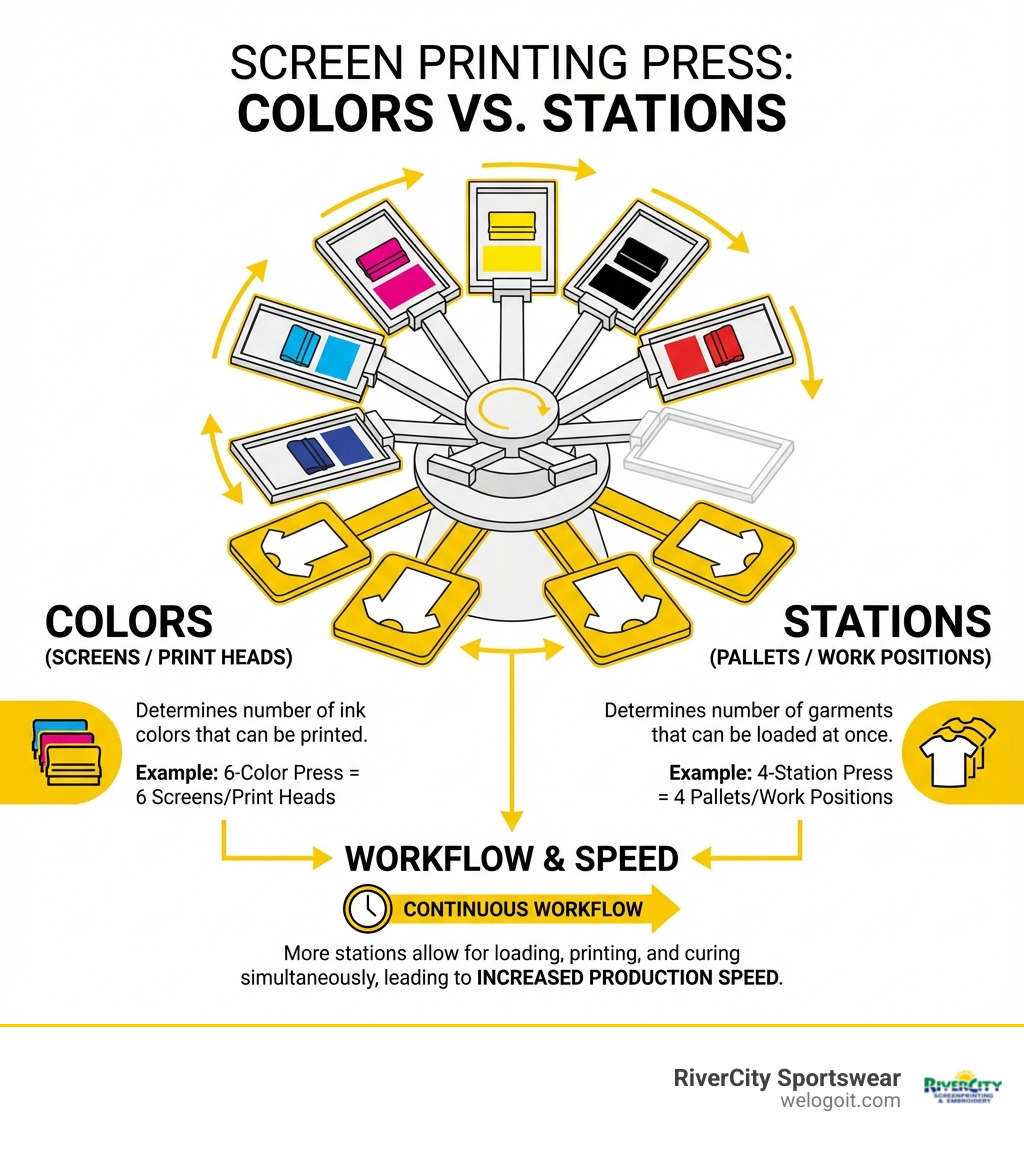
- Colors vs. Stations: A 6-color, 4-station press holds 6 screens for printing up to 6 colors and can have 4 shirts loaded simultaneously—more stations mean faster production
The key distinction in any press is simple: colors determine how many different ink layers you can print, while stations determine how many garments you can work on at once. A press with more stations allows you to load, print, and cure garments continuously, dramatically increasing your output.
Manual presses range from simple 1-color tabletop models at $275 to robust 8-color, 6-station floor models around $6,700. Automatic presses start around $10,000 and can exceed $50,000 for advanced systems capable of over 1,600 prints per hour.
Understanding duty levels matters too. Light-duty presses (1-year warranty) suit hobbyists with basic features and 1-4 configurations. Medium-duty presses (3-year warranty) offer micro-registration and 1-8 configurations for growing shops. Heavy-duty presses (25-year warranty) provide the most solid construction and efficient registration systems for serious production environments.
I’m Luke Sanders, and as CEO of RiverCity Screenprinting & Embroidery for over 15 years, I’ve worked with every type of screen printing press from entry-level manual models to high-speed automatics, helping grow our operation into one of Texas’s largest promotional product producers. Whether you’re just starting out or ready to scale, this guide will help you find the press that fits your budget and business goals.
Manual vs. Automatic: Which Press is Right for You?
When it comes to selecting a screen printing press, the first major decision you’ll face is whether to go manual or automatic. This choice profoundly impacts your production volume, cost, labor requirements, and overall consistency. It’s not just about what you can afford today, but what your business needs to grow in the long run.
What is a manual screen printing press?
A manual screen printing press is exactly what it sounds like—you’re doing most of the work by hand. These presses require the operator to manually load garments, rotate the platen (shirt board), lower the screen, pull the squeegee to apply ink, and then raise the screen. It’s a hands-on process that gives you intimate control over each print.
Manual presses are often the starting point for hobbyists, startups, and small businesses in Central Texas looking to get into screen printing. Their lower initial cost makes them accessible, and they’re perfect for learning the craft, experimenting with designs, and handling smaller batches. You’ll find compact 1 and 4-color tabletop models, like the Riley Hopkins 150 series, ideal for hobbyists. These entry-level options allow you to print on various items, from garments and face masks to can holders and promotional items.
While they demand more physical labor and are slower than their automatic counterparts, manual presses offer incredible flexibility. They can be a fantastic way to develop your skills and produce high-quality, custom work without a massive upfront investment. Many successful shops in Austin started with a manual press, proving you can certainly grow a business from the ground up.
What is an automatic screen printing press?
An automatic screen printing press is a powerhouse designed for high-speed, consistent production. Once set up, these machines automate most of the printing process, from lowering the screen and applying ink with precise pressure to lifting the screen and rotating the platen. This significantly reduces the physical labor involved and ensures remarkable consistency across thousands of prints.
For businesses in San Marcos or South Texas dealing with large orders, an automatic press is a game-changer. They offer impressive production rates; for example, the ROQ ECO automatic screen printing press can achieve over 1,600 prints per hour, and even more with FLY Mode, while the ROQ FIT can manage over 1,000 prints per hour. This kind of speed is crucial for meeting tight deadlines and handling high-volume demands.
Automatic presses come with a higher initial investment, but they pay off quickly through increased output and reduced labor costs. They are built for efficiency, often featuring advanced systems like integrated special FX printing, digital micro-registration displays on every print head, and even digital hybrid capabilities for future-proofing. For instance, the M&R Gauntlet press, which we’ve used in our own facility, can handle up to 8 colors with 10 printing stations, allowing us to run over 600 shirts per hour efficiently.
Automatic presses can be electric or pneumatic. Electric models, like some compact ROQ presses, can eliminate the need for bulky external compressors, fitting into tighter spaces.
Here’s a quick comparison to help you weigh your options:
| Feature | Manual Screen Printing Press | Automatic Screen Printing Press |
|---|---|---|
| Speed | Slower (50-200 prints/hour, highly operator-dependent) | Very Fast (600-2,000+ prints/hour) |
| Cost | Lower initial investment ($275 – $6,700+) | Higher initial investment ($10,000 – $100,000+) |
| Labor | High physical labor, multiple operators per press for speed | Low physical labor, typically one operator for multiple presses |
| Consistency | Good, but can vary with operator fatigue and skill | Excellent, highly repeatable results |
| Setup Time | Generally quicker for simple jobs | Can be longer for complex jobs, but faster for repeat jobs with memory |
| Ideal User | Hobbyists, startups, small runs, custom jobs, learning | High-volume production, large orders, businesses scaling rapidly |
| Footprint | Smaller, tabletop or compact floor models | Larger, often requiring dedicated production space |
| Maintenance | Simpler, mostly mechanical | More complex, involves electrical, pneumatic, and mechanical systems |
Key Features of a Modern Screen Printing Press
Once you’ve decided between manual and automatic, it’s time to dive into the specifics. Modern screen printing presses come with a host of features that can dramatically impact your print quality, efficiency, and the longevity of your investment. We always advise our clients to look beyond the basic function and consider the build quality, warranty, scalability, and manufacturer support that comes with the equipment.
Colors and Stations: Expanding Your Capabilities
The terms “colors” and “stations” are fundamental to understanding a screen printing press’s capabilities.
- Colors (or Print Heads): This refers to the number of screens a press can hold simultaneously. Each screen is prepared with a different part of your design and corresponds to a single ink color. If your design has six colors, you’ll need a press with at least six print heads. The more colors a press can handle, the more complex and vibrant designs you can produce without multiple setups.
- Stations (or Platens/Pallets): These are the flat boards where you load your garments. The number of stations dictates how many shirts you can have on the press at any given time.
The interplay between colors and stations directly affects your production speed and capability. For example, a 6-color, 4-station press means you can print up to 6 colors (holding 6 screens), and you can have 4 shirts loaded on it at a time. The higher the number of stations, the faster your production rate. As one shirt is being printed, another can be loaded, a third can be flash-dried, and a fourth can be unloaded, creating a continuous, efficient workflow. This is how we maximize efficiency for our clients across Austin and Central Texas.
Why Micro-Registration is a Non-Negotiable Feature
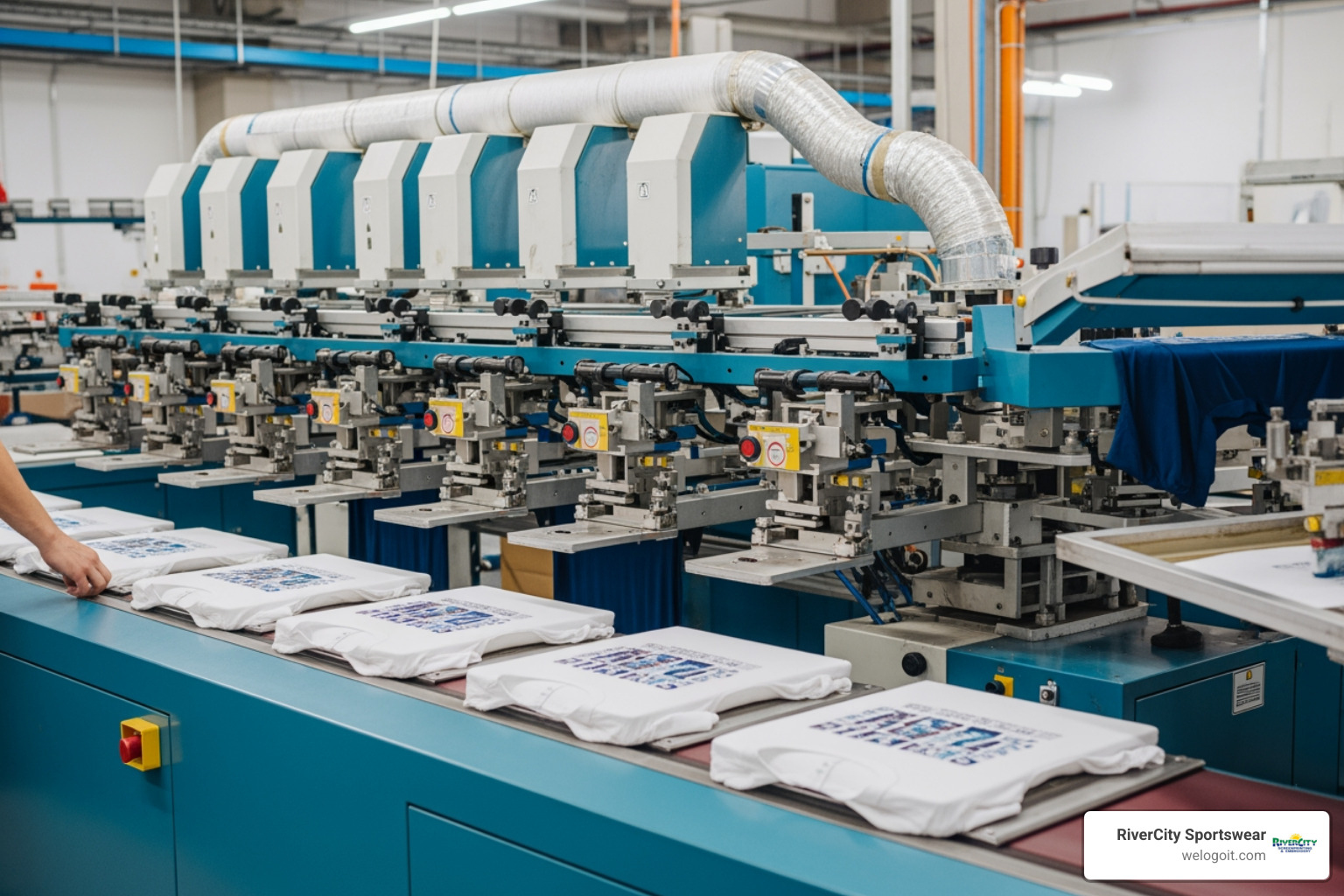
If you’re serious about print quality, especially with multi-color designs, micro-registration is an absolute must-have feature on your screen printing press. It’s the unsung hero that ensures your colors line up perfectly, preventing blurry or misaligned prints.
Micro-registration systems allow for incredibly precise adjustments of your screens in three dimensions:
- X-axis: Left and right movement.
- Y-axis: Forward and backward movement.
- Z-axis: Up and down movement, controlling the off-contact (distance between the screen and the garment).
These fine-tuning capabilities are crucial for achieving crisp, professional results. Without micro-registration, aligning multiple colors on a complex design can be a frustrating, time-consuming, and often inaccurate process, leading to excessive waste and rework. With it, you can quickly make minute adjustments to ensure each color hits its mark. This not only lifts your print quality but also significantly reduces setup time and eliminates costly misprints, saving you time and money.
For example, Vastex’s heavy-duty presses boast the “most solid structure and most efficient micro-registration in the industry,” a testament to its importance. Riley Hopkins presses also feature XY or XYZ micro-registration, highlighting its critical role in delivering professional-grade prints.
Choosing Your Press by Budget and Scale
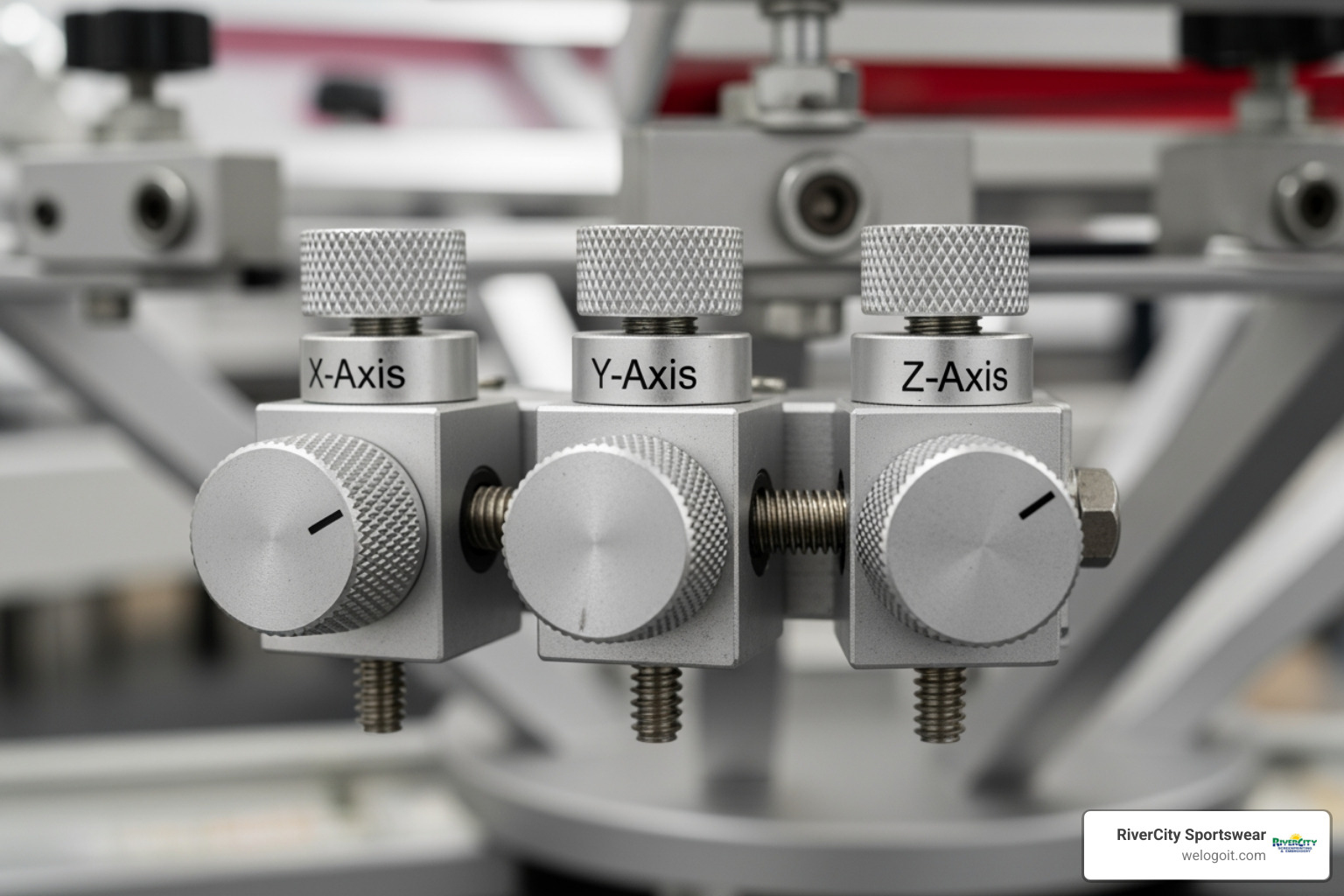
Navigating screen printing presses can feel overwhelming, but by aligning your budget with your current and future production scale, you can make an informed decision. We’ve seen countless businesses in Texas grow from small startups to thriving enterprises, and the right equipment at each stage is crucial. It’s about investing wisely to ensure a healthy return and the ability to expand as demand grows.
Entry-Level & Hobbyist Presses (Under $1,000)
For those just dipping their toes into the vibrant world of screen printing, or for hobbyists and small startups in San Marcos, entry-level presses offer an affordable gateway. These typically include:
- 1-4 color models: Allowing for simple to moderately complex designs.
- 1 station: Meaning you print one garment at a time, then rotate it to the next color or remove it.
- Tabletop configuration: Compact and designed to sit on a workbench, making them suitable for home use or small workshops.
These presses are characterized by their basic features, but they are robust enough for learning the fundamentals and producing small batches of custom items. For instance, the Riley Hopkins 150 series offers a 1-color, 1-station press for around $275 and a 4-color, 1-station model for approximately $629.95. Vastex also offers the V-10 CraftPrinter, a low-cost tabletop press designed for one-color prints on various items. These presses are excellent learning tools and perfect for low-volume production or personalized projects.
Mid-Range Presses for Growing Businesses ($1,000 – $5,000)
As your business grows and demand increases, you’ll quickly find that an entry-level press might limit your potential. Mid-range presses are designed for growing businesses in Austin and Central Texas that need more capacity and advanced features without breaking the bank. These presses typically offer:
- 4-6 color models: Enabling more intricate, multi-color designs.
- 2-4 stations: Significantly improving workflow efficiency and production speed compared to single-station models.
- Floor-standing designs: Providing greater stability and often a larger print area.
- Micro-registration: A crucial feature for precise alignment of multiple colors, as we discussed earlier.
- Steel pallets: Offering increased durability and heat resistance for consistent prints.
These presses strike a balance between affordability and capability. They are built for medium-volume production and can handle more complex jobs with greater consistency. Vastex’s light-duty V-100 series (1-year warranty) and medium-duty V-1000 series (3-year warranty) fall into this category, offering up to 4 and 8 stations/print heads respectively, often with micro-registration on the V-1000. The Riley Hopkins 250 series is another excellent example, with a 4-color, 2-station press at $2,399.95 or a 6-color, 4-station press at $3,699.95, both featuring XY Micro Registration. These presses are built to grow with you, providing a solid foundation for scaling your operations.
Commercial-Grade Presses for High-Volume Shops ($5,000+)
For established businesses and high-volume production facilities in Texas, commercial-grade presses are the ultimate investment. These machines are engineered for maximum efficiency, durability, and advanced capabilities, ensuring you can meet the demands of large orders and specialized printing.
This category includes:
- 6-10+ colors and stations: Allowing for highly complex, multi-color designs and continuous, high-speed production.
- Heavy-duty construction: Built to withstand the rigors of constant, industrial use. Vastex’s V-2000HD series, for instance, comes with an impressive 25-year warranty, highlighting its robust build.
- Advanced features: Such as integrated flash curing, digital control panels, and highly efficient micro-registration systems (like the XYZ Micro Registration on Riley Hopkins 360 series).
- Automation: Many presses in this range are fully automatic, drastically increasing output and consistency.
Examples include the Riley Hopkins 360 series, with models like a 6-color, 4-station press for $4,999.95 or an 8-color, 6-station press for $6,699.95, designed to boost any high-production shop. For the pinnacle of production, automatic presses like those from ROQ offer unparalleled speeds, with some models achieving over 1,600 prints per hour. Even specialized machines like the ROQ HYBRID Digital Automatic Printer can achieve over 200 unique prints per hour, blending digital and screen printing for unique effects. While the upfront cost is significant, these presses offer the lowest cost per print and the highest return on investment for businesses with consistent high-volume orders.
Building Your Print Station: Essential Accessories
A screen printing press is the heart of your operation, but it’s far from the only piece of equipment you’ll need. To create a complete and efficient print station, especially for clients across Central and South Texas, you’ll need several essential accessories and related equipment.
- Platens: These are the interchangeable boards that garments are loaded onto. Different sizes and shapes are available for various items like t-shirts, sleeves, hats, and even specialty items. Having a range of platens ensures versatility.
- Flash Dryers: These are crucial for multi-color printing. A flash dryer cures the ink on one color layer enough so that the next color can be printed on top without smudging. They also partially cure ink between stations on a multi-station press. Riley Hopkins offers various flash dryers, including 18″ x 24″ and 18″ x 18″ models.
- Conveyor Dryers: After all colors are printed, garments pass through a conveyor dryer for a final, thorough cure. This process permanently sets the ink, making it washable and durable. Forced air conveyor dryers, like the RileyCure series (e.g., 8ft long x 24in wide belt for $8,579.95), are essential for professional results and high-volume shops.
- Inks: The lifeblood of screen printing! We primarily use water-based inks, including high solid acrylic and discharge systems, which are more eco-friendly and result in a softer feel on garments. We also offer specialty inks like metallic, fluorescent, and athletic inks for specific applications.
- Emulsion: This light-sensitive liquid is applied to screens to create the stencil for your design.
- Squeegees: Used to push the ink through the screen’s mesh onto the garment. Different durometers (hardness) and sizes are available for various inks and print applications.
- Screens: The mesh frames where your design stencil is created. Different mesh counts are used depending on the ink type and desired detail.
- Cleaning Chemicals: Proper cleaning of screens and equipment is vital for longevity and consistent results. We use plant-based cleaners for our screens, avoiding harsh solvents.
For those interested in specialized printing techniques, you can Learn more about discharge screen printing to understand how it can create incredibly soft, breathable prints by dyeing the fabric itself.
Frequently Asked Questions about Screen Printing Presses
We often get asked many questions about screen printing presses from our clients and partners across Texas. Here are some of the most common ones, along with our expert answers.
How does the number of stations affect production speed?
The number of stations on your screen printing press directly dictates your production speed. Think of it like an assembly line. With more stations, you can have multiple garments in different stages of the printing process simultaneously. For example, while one person loads a fresh shirt onto a platen, another shirt is being printed, a third is passing under a flash dryer for an inter-color cure, and a fourth is being unloaded. This continuous workflow eliminates bottlenecks and allows you to constantly keep the press moving.
A press with more stations means less downtime between prints, which translates to a significantly higher number of garments printed per hour. This is especially critical for large orders where efficiency directly impacts profitability. For our high-volume runs, having numerous stations on our automatic presses allows us to hit impressive print rates, ensuring fast turnaround times for our customers.
Can I upgrade my screen printing press later?
The ability to upgrade your screen printing press is a vital consideration, especially for businesses that anticipate growth. Some press systems are designed with modularity in mind, allowing you to add more stations or print heads as your business expands. For instance, some manual presses can be upgraded from a 4-color to a 6-color setup, or you might be able to add extra platens. Automatic presses, particularly some oval models, are often designed with modularity, allowing for future expansion in colors and platens to adapt to unique spaces and growth.
However, not all presses are built this way. Many entry-level or fixed-configuration presses cannot be easily upgraded. It’s crucial to evaluate your long-term business goals when purchasing a press. If you foresee significant growth in print volume or complexity, investing in a modular system or a press from a brand known for its scalable solutions (like Riley Hopkins, which are “built to grow with you”) can save you money and headaches down the road. Planning ahead can prevent you from needing to sell and repurchase an entirely new system in just a few years.
What kind of maintenance does a screen printing press require?
Like any piece of industrial equipment, a screen printing press requires regular maintenance to ensure optimal performance and longevity. Ignoring maintenance can lead to costly breakdowns, inconsistent prints, and premature wear.
Basic maintenance for both manual and automatic presses includes:
- Daily Cleaning: Thoroughly cleaning all ink off the press, especially the platens, screens, and squeegees, after each use. This prevents dried ink from affecting future prints and keeps the equipment in good condition.
- Lubrication: Regularly lubricating all moving parts, such as bearings, hinges, and rotating mechanisms, according to the manufacturer’s guidelines. This reduces friction and prevents wear.
- Inspections: Periodically checking all bolts and fasteners to ensure they are tight. Vibration from printing can loosen components over time.
- Leveling: Ensuring your platens are perfectly level is crucial for consistent ink application and print quality. Check and adjust them regularly.
For automatic presses, maintenance can be more involved:
- Pneumatic Systems: If your press uses air pressure (pneumatic), you’ll need to check air lines, filters, and lubricators regularly.
- Electrical Systems: Inspecting wiring and connections, and ensuring all safety features are operational.
- Software Updates: Automatic presses often have digital control systems that may require software updates.
Proper maintenance not only extends the life of your press but also ensures that every print coming off your machine meets the high-quality standards our clients in Austin expect.
Conclusion
Choosing the right screen printing press is a pivotal decision for any business, whether you’re just starting out or looking to boost your high-volume operations. We’ve explored the different types, key features, and considerations across various budgets, emphasizing how each choice impacts your production speed, print quality, and ultimately, your business’s ability to scale.
From the hands-on control and affordability of a manual press perfect for a startup in San Marcos, to the blistering speed and consistency of an automatic press that empowers large-scale production in Austin, there’s a perfect machine for every goal. Remember to prioritize features like colors and stations for expanding your capabilities, and never underestimate the importance of micro-registration for achieving flawless, multi-color designs.
At RiverCity Sportswear, we understand the intricacies of screen printing because we live it every day. Our experience, from humble beginnings to becoming one of Texas’s largest promotional product producers, has taught us that the right equipment, coupled with exceptional service and personalized design support, is the key to success.
Ready to take the next step in your screen printing journey, or need expert advice on how to scale your operations in Central or South Texas? Don’t get pressed by the choices; let us help you find the perfect fit.
Get expert advice on your screen printing needs
Original Post: Don’t Get Pressed: Top Screen Printing Machines for Every Budget


Comments
Post a Comment