Get Pressed for Success: The Best T-Shirt Presses for Your Business
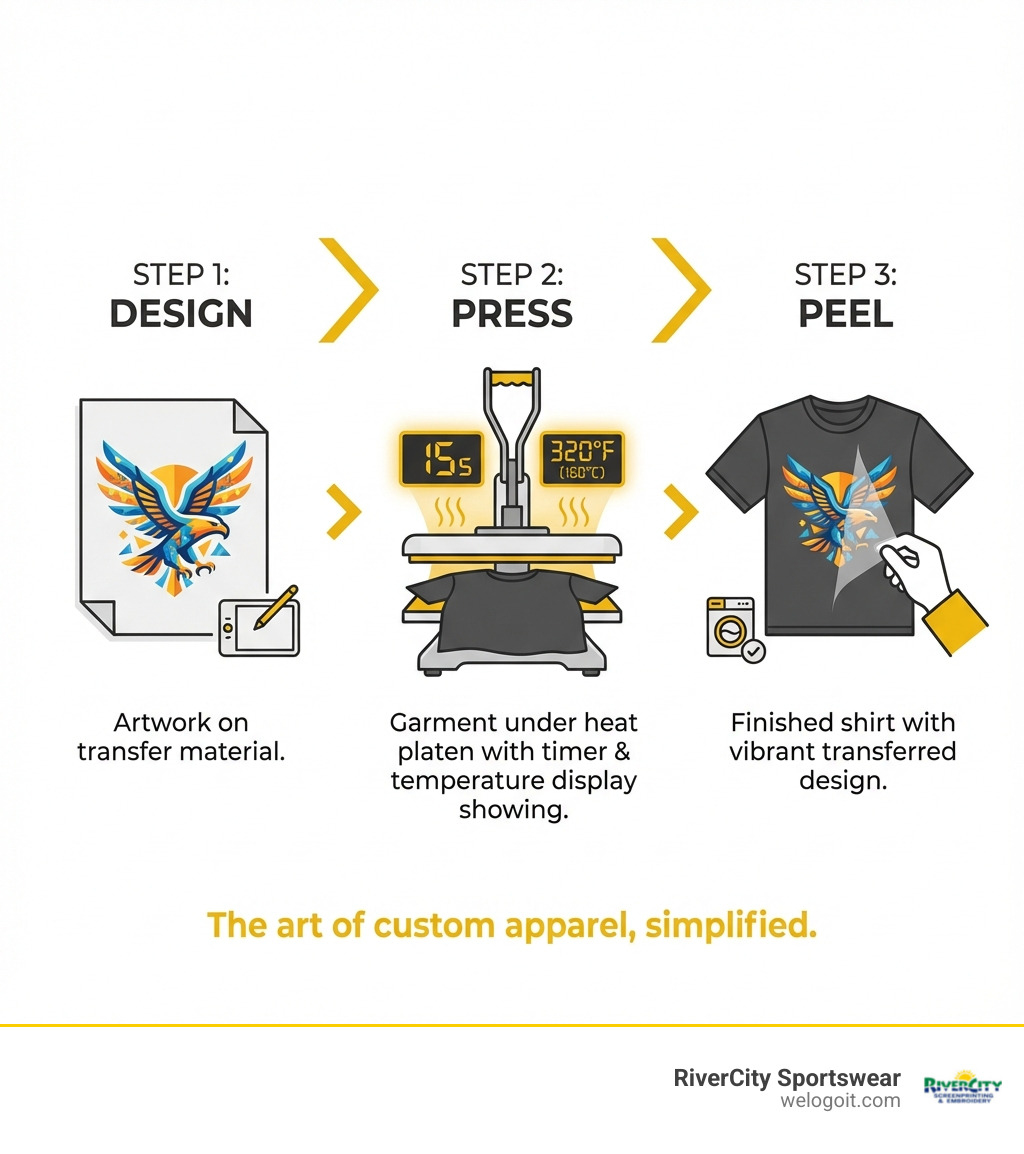
Why Every Custom Apparel Business Needs the Right T-Shirt Press
A tshirt press (also called a heat press) is a machine that uses heat and pressure to transfer designs onto fabric. If you’re comparing different models, here’s what matters most:
- Clamshell presses are compact and affordable, ideal for small spaces and thin garments
- Swing-away presses offer better access and safety, perfect for thicker items and uneven surfaces
- Drawer presses combine ease of loading with professional features for high-volume production
- Key specs to compare: platen size (12×15″ to 16×20″), digital temperature controls, adjustable pressure, and whether it accepts interchangeable platens
The global heat press machine market was valued at $1.1 billion in 2022 and is projected to reach $1.8 billion by 2030. That growth reflects a simple truth: consumers want unique, personalized apparel, and businesses need reliable equipment to deliver it fast.
Whether you’re pressing 50 shirts for a corporate event or 500 jerseys for a sports league, your heat press is the most important tool in your operation. It’s the difference between designs that peel after one wash and professional-quality transfers that last for years.
But here’s the challenge—not all heat presses are created equal. The right machine for a hobbyist working out of their garage looks very different from what a production shop needs. Size, features, and price points vary wildly, and choosing wrong can cost you time, money, and frustrated customers.
I’m Luke Sanders, CEO of RiverCity Screenprinting & Embroidery, where we’ve been producing high-quality custom apparel for over 40 years. While we specialize in screen printing and embroidery, I’ve worked alongside countless clients who use tshirt presses for their businesses, and I understand what separates equipment that delivers from equipment that disappoints.
How a T-Shirt Press Works
At its core, a tshirt press operates on a simple yet highly effective principle: applying controlled heat and pressure over a specific duration to bond a transfer material onto a garment. Think of it as a super-powered, precision iron designed specifically for fabric decoration.
The machine consists of a few key components:
- Heat Platen: This is the top plate, which contains heating elements that warm up to a precise temperature. Our goal is to ensure this heat is distributed evenly across the entire surface to activate the adhesive in your transfer material.
- Lower Platen: This is the flat, often silicone-covered, bottom surface where you lay your garment. It provides a firm, heat-resistant base for the pressing process.
- Pressure System: Depending on the press type, this system applies downward force from the heat platen onto the garment and transfer. Consistent and adjustable pressure is crucial for a strong bond.
- Digital Controls: Most modern tshirt presses come with digital displays that allow us to set and monitor time and temperature with accuracy. Some advanced models even offer pressure readouts.
When we place a garment with a transfer on the lower platen and close the press, the heat from the top platen melts the adhesive on the transfer. Simultaneously, the pressure forces the melted adhesive into the fibers of the fabric. The timed duration ensures the adhesive has enough time to properly bond before the press opens. This combination of time, temperature, and pressure is what activates the transfer material and creates a durable, professional-looking design. It’s a delicate balance, and getting it right is the secret to a successful, long-lasting print. For a general overview of the equipment, see the Wikipedia entry on the heat press.
Types of T-Shirt Presses
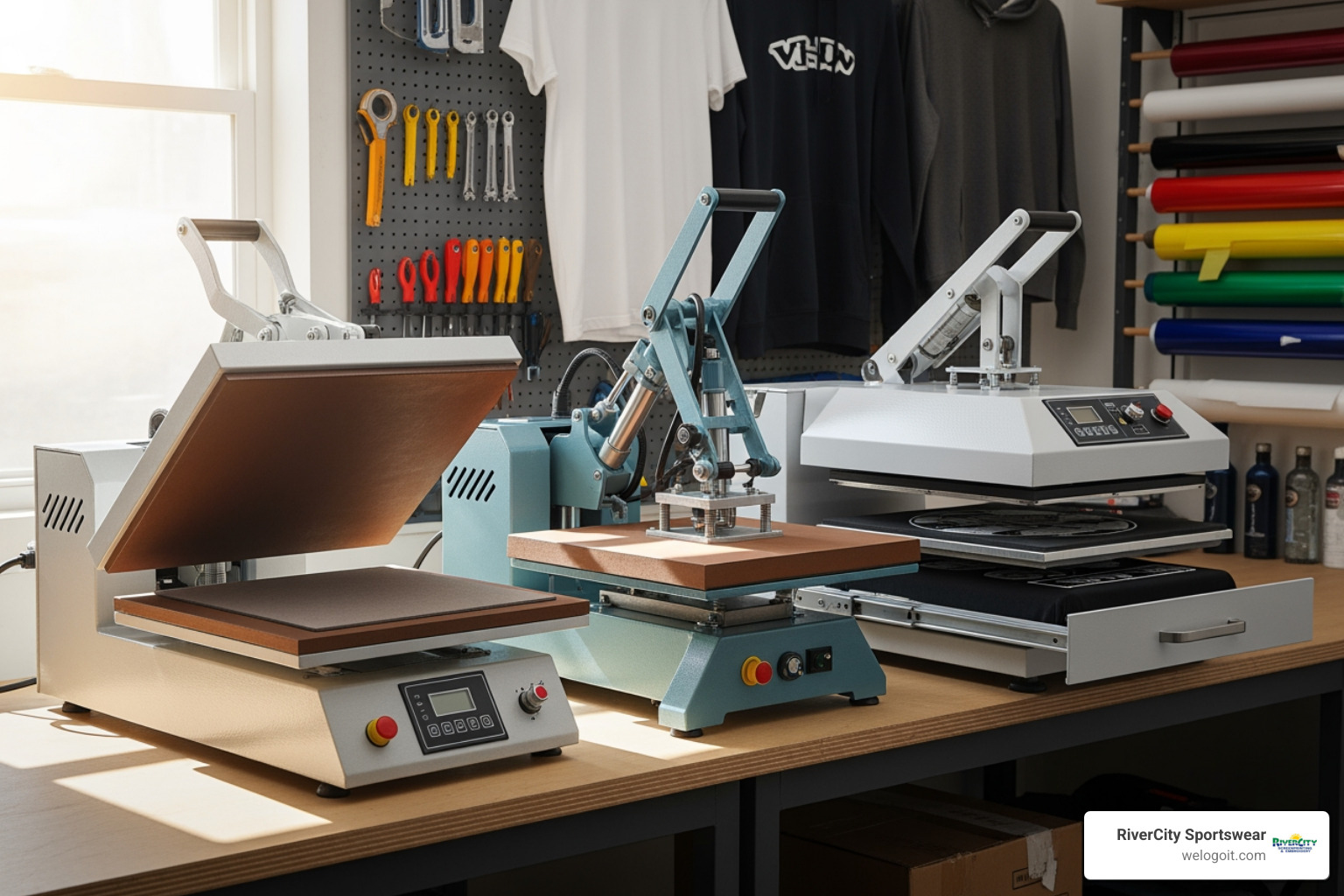
Choosing the right tshirt press is like choosing the right tool for a job – a hammer is great for nails, but not so much for screws! Each press type has its strengths, making it suitable for different business models, production volumes, and workspace considerations. Let’s explore the main contenders:
The Clamshell Press
The clamshell press is probably what most people visualize when they think of a tshirt press. It’s named for its design, where the top heat platen opens and closes like a clamshell.
- Space-saving design: Clamshell presses are generally more compact than other types, making them an excellent choice for smaller workshops or home-based businesses in places like San Marcos or Austin where space might be at a premium.
- Fast production speed: Because the platen just hinges up and down, it’s quick to open and close, allowing for faster production of single items. This can be a boon when you’re knocking out a stack of custom shirts.
- Ideal for thin garments: They work exceptionally well for flat, thinner items like t-shirts, tote bags, or pillowcases.
Pros: Affordable, compact, quick to operate.
Cons: Limited access to the lower platen can make precise garment alignment tricky, and the angling of the top platen can sometimes lead to uneven pressure on thicker items or near seams. You also need to be very careful to avoid accidentally touching the hot upper platen when laying out your garment.
The Swing-Away Press
The swing-away press offers a different approach to heat pressing. Instead of lifting straight up, the top heat platen “swings” away from the lower platen.
- Full platen access: This design completely moves the hot platen out of the way, providing unobstructed access to the lower platen. This is a huge advantage for safely arranging garments and transfers, especially when dealing with multiple colors or intricate designs.
- Safer operation: With the heat source completely out of the way, the risk of accidental burns is significantly reduced. This is a major safety consideration for any busy shop.
- Good for thicker items: The direct downward pressure ensures even heat distribution and consistent pressure, making it ideal for thicker items like hoodies, jackets, or even ceramic tiles.
- Even pressure: The straight-down pressure mechanism is superior for achieving consistent results across the entire transfer area, reducing the chance of cold spots or uneven adhesion.
Pros: Greater safety, excellent for precise placement, delivers even pressure, versatile for various item thicknesses.
Cons: Requires more counter space due to the swinging motion, and typically comes with a higher price tag than a clamshell.
The Drawer Press
The drawer press, sometimes called a “pull-out” press, combines features from both clamshell and swing-away designs. The top platen usually lifts straight up, but the bottom platen slides out like a drawer.
- Slide-out lower platen: This is its defining feature. The lower platen slides out towards the operator, offering full, safe access for loading and unloading garments.
- Easy garment alignment: Much like a swing-away, the ability to work on the lower platen away from the heat makes garment and transfer placement much easier and more accurate. This is particularly useful for delicate items or multi-step applications.
- Ergonomic benefits: For businesses in Central Texas with higher production volumes, the slide-out design can be less strenuous on operators over long shifts, as they don’t have to reach under a hot platen.
- Hybrid design: It offers the safety and ease of a swing-away with a potentially smaller footprint than some swing-away models.
Pros: Excellent safety, ergonomic, easy for precise alignment, good for various item types.
Cons: Can be more expensive than clamshells, and the sliding mechanism might require more maintenance over time.
How to Choose the Right Tshirt Press
Selecting the perfect tshirt press for your business is a strategic decision that impacts efficiency, quality, and profitability. It’s not just about finding the cheapest option or the one with the most bells and whistles; it’s about aligning the machine with your specific needs and ambitions.
We’ve seen businesses in Austin and San Marcos flourish when they invest in the right equipment. Here’s what we recommend you consider:
- Business goals: Are you planning a small hobby business, or do you envision a high-volume custom apparel empire? Your goals will dictate the durability, speed, and features you need.
- Production volume: How many items do you anticipate pressing per day, week, or month? Low volume might tolerate a manual clamshell, while high volume demands an automatic or semi-automatic swing-away or drawer press.
- Budget: This is often a primary constraint. We’ll dive into cost ranges shortly, but a higher initial investment can often mean greater reliability and efficiency in the long run.
For a deeper dive into making this crucial decision, we highly recommend checking out this detailed guide: A Guide to Choosing Your Press.
Key Features for Your Tshirt Press
Beyond the basic type, several features contribute to the performance and versatility of a tshirt press:
- Platen size: This determines the maximum size of the design you can press and the largest garment area you can work with. Common sizes range from 9×12 inches for small projects up to 16×20 inches for adult apparel or larger graphics. If you plan to press full-back designs or oversized shirts, a larger platen is essential. Some presses offer interchangeable platens, which is incredibly useful for pressing sleeves, pant legs, or smaller items like koozies.
- Digital time and temperature controls: Precision is paramount. Digital controls allow you to set exact temperatures (e.g., 320°F) and times (e.g., 15 seconds), which is critical for consistent results across different transfer materials. Manual dials can be inaccurate and lead to ruined garments.
- Pressure readout: While many presses have an adjustable pressure knob, a digital pressure readout (or a simple pressure gauge) helps us maintain consistent pressure for every press. This eliminates guesswork and ensures uniform application, especially vital for heat transfer vinyl (HTV) and sublimation.
- Interchangeable platens: For businesses looking to diversify beyond just t-shirts, the ability to swap out the main platen for smaller ones (like sleeve platens, cap platens, or even mug attachments on multi-function presses) adds immense value. This versatility allows us to tackle a wider range of custom products without needing multiple machines.
Understanding the Cost of a Tshirt Press
The cost of a tshirt press can vary as widely as the features they offer. It’s important to understand what you’re getting for your money and how it aligns with your business model.
- Entry-level price range: For hobbyists or those just starting out with very low volume, you might find handheld heat presses or small clamshell models in the $100-$300 range. These are often compact, like the Cricut EasyPress models, and can be great for personal projects or testing the waters. However, they typically offer less consistent pressure and heat than commercial machines.
- Hobbyist vs. professional machines: As you move up, dedicated desktop clamshell or basic swing-away presses for small businesses typically fall into the $300-$800 range. These offer better build quality, more precise digital controls, and more consistent pressure, making them suitable for growing businesses or those producing custom apparel for local clients in our Texas communities.
- Mid-range investments: For established small to medium-sized businesses with moderate production volumes, mid-range swing-away or drawer presses can cost anywhere from $800-$2,000. These machines often feature larger platens, more robust construction, and advanced features like auto-open functionality, which can significantly improve workflow and reduce operator fatigue.
- High-volume production costs: Industrial-grade, automatic, or semi-automatic presses designed for continuous, high-volume production can range from $2,000 to $5,000+. These are built for durability, speed, and precision, often featuring pneumatic pressure systems, dual platens, and advanced digital interfaces. While a significant investment, they are essential for businesses handling large orders and demanding consistent, flawless results day in and day out.
The initial cost is just one factor. Consider the warranty, customer support, and availability of replacement parts when making your decision. A cheap press that breaks down frequently or produces inconsistent results can end up costing you more in the long run due to lost time and wasted materials.
Mastering Your Materials and Settings
Once you have your tshirt press, the real fun begins: bringing your designs to life! But a great press is only half the equation. Understanding your transfer materials and the specific settings they require is crucial for achieving professional, long-lasting results. We’ve certainly learned a thing or two about this over our decades in the custom apparel business.
Common T-Shirt Transfer Methods
There are several popular methods for transferring designs onto t-shirts using a heat press, each with its unique characteristics and ideal applications.
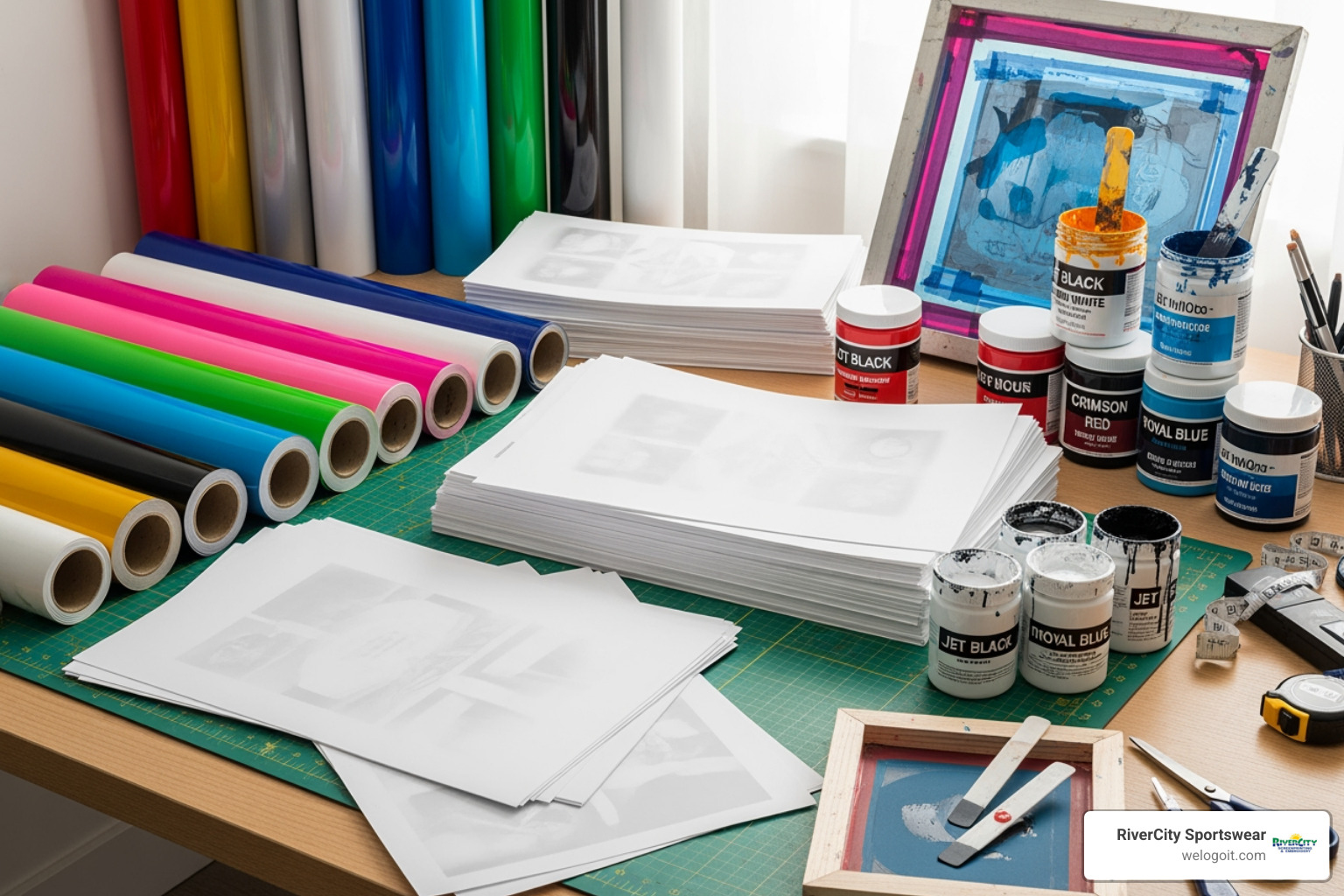
- Heat Transfer Vinyl (HTV): This is probably the most widely used method for custom apparel, particularly for individual names, numbers, logos, and bold graphics. HTV comes in various colors, textures (glitter, flock, metallic, reflective, puff), and finishes. It’s cut with a vinyl cutter, weeded, and then pressed onto the garment. HTV is known for its durability and vibrant colors, and it works on a wide range of fabrics.
- Sublimation: This method is fantastic for vibrant, full-color designs with photographic quality. Sublimation ink turns into a gas when heated, permeating the fibers of polyester fabrics. The result is a print that feels completely smooth to the touch, as the ink becomes part of the fabric itself. It’s incredibly durable and won’t crack or peel. However, it only works effectively on polyester or poly-coated items and works best on light-colored fabrics.
- Screen printing options available from RiverCity Sportswear: While a tshirt press is excellent for HTV and sublimation, we at RiverCity Sportswear specialize in traditional screen printing for bulk orders and intricate designs. Our water-based inks offer a super-soft feel, and our discharge printing option dyes the shirt itself, making the print feel like part of the fabric. For larger runs, or when you need that classic, durable screen-printed look, our services provide best quality and efficiency. We offer a wide array of water-based inks from super soft RC ink to heavier handed hi-opacity ink for printing on darker colored garments. We even offer specialty athletic inks for darker synthetic materials on larger orders. Our maximum print size is 14 inches wide by 16 inches tall, perfect for most apparel. You can learn more about our screen printing services here.
Pairing Transfers with Fabrics
The type of fabric you’re pressing onto is just as important as the transfer method itself. A mismatch can lead to a quickly deteriorating design or even damage to the garment.
- Cotton compatibility: Cotton is a versatile fabric that works well with most HTV types. It’s breathable and takes heat well. For screen printing, especially with our water-based and discharge inks, 100% cotton is ideal for the softest feel. We also work with 50/50 blends and tri-blends for various apparel options.
- Polyester for sublimation: Sublimation is almost exclusively for polyester fabrics (or items with a high polyester count). The higher the polyester content, the more vibrant and permanent the sublimation print will be. Pure cotton will not hold a sublimation print effectively.
- Blends: Cotton/polyester blends can be tricky. Many HTV products are designed to work on blends. For sublimation, a higher polyester percentage (e.g., 65% polyester or more) will yield better, though sometimes slightly faded, results. For screen printing on blends, an underbase might be needed for dark colors to achieve optimal vibrancy.
- Fabric limitations: Always check the manufacturer’s recommendations for both your transfer material and your garment. Some delicate fabrics, or those treated with water-repellents, might not be suitable for heat pressing. Pre-shrinking garments can also prevent design distortion after washing.
Ideal Time, Temperature, and Pressure
The “magic trinity” of heat pressing is time, temperature, and pressure. These three elements must be perfectly calibrated for a successful transfer. Always refer to the specific instructions provided by your transfer material manufacturer, as settings can vary. However, here’s a general guide for common applications:
| Transfer Method | Fabric Type | Temperature (°F) | Time (Seconds) | Pressure |
|---|---|---|---|---|
| HTV | Cotton | 305-320 | 10-20 | Medium |
| HTV | Polyester | 280-300 | 10-15 | Medium |
| Sublimation | Polyester | 380-400 | 30-60 | Medium-Firm |
Important Notes:
- Pre-pressing: Always pre-press your garment for 3-5 seconds before applying the transfer. This removes moisture and wrinkles, ensuring a smooth, even surface for adhesion.
- Teflon sheets: Use a Teflon sheet or parchment paper between your heat platen and the transfer to prevent scorching and keep your platen clean.
- Hot vs. Cold Peel: Some HTV requires a “hot peel” (peeling the carrier sheet immediately after pressing), while others require a “cold peel” (waiting for it to cool down). Follow instructions carefully!
Frequently Asked Questions about T-Shirt Presses
We often hear similar questions from those new to tshirt presses or looking to refine their techniques. Here are some of the most common ones we encounter:
Can I use a regular iron instead of a heat press?
This is a classic question, and while the thought is tempting for a quick DIY project, our answer is a resounding “we don’t recommend it for professional results.”
- Even pressure issues: A household iron, by design, cannot provide the consistent, even pressure that a tshirt press does. You might press down hard, but the pressure will be unevenly distributed, leading to spots where the transfer hasn’t fully adhered.
- Inconsistent heat: Irons also lack precise temperature control. They fluctuate, and their heating surface is much smaller, meaning you’ll have to move it around, risking uneven heating across your design.
- Professional results: The result? Transfers that peel, crack, or wash off quickly. If you’re aiming for anything beyond a one-time wear, a dedicated tshirt press is an absolute necessity. It’s the difference between a craft project and a truly professional, durable custom garment. For a serious business, a heat press is the only investment you need to get started.
What are the most important safety precautions?
Safety first, always! Tshirt presses operate at high temperatures and exert significant force. Ignoring safety can lead to serious burns or injuries.
- Hot surfaces: The heat platen gets incredibly hot (300-400°F!). Always be mindful of where your hands are. We recommend keeping the press on a solid, level surface with plenty of clear space around it.
- Proper ventilation: Some transfer materials, especially during the initial heat-up, can release fumes. Ensure your workspace is well-ventilated.
- Electrical safety: Plug your tshirt press into its own dedicated outlet to avoid overloading circuits, especially for larger, more powerful machines. Never use extension cords unless they are rated for the machine’s wattage.
- Manufacturer instructions: Always read your specific machine’s manual. It contains critical safety information and operational guidelines unique to your model. Keep it handy!
What are some common troubleshooting tips?
Even with the best equipment and careful attention, you might run into issues. Don’t worry, we’ve all been there. Here are some common problems and their solutions:
- Vinyl not sticking:
- Check time/temperature: Is your press hot enough? Are you pressing long enough? Refer to the HTV manufacturer’s instructions.
- Check pressure: Is the pressure firm enough? If it’s too light, the adhesive won’t bond properly. Adjust your pressure settings.
- Pre-press: Did you pre-press the garment? Moisture is the enemy of adhesion!
- Cold peel issues: If it’s a cold peel vinyl, are you peeling too soon? Let it cool completely.
- Scorched fabric:
- Temperature too high: Reduce the temperature.
- Time too long: Shorten the pressing time.
- Protection: Are you using a Teflon sheet or parchment paper? This is crucial for protecting the garment and the platen.
- Uneven transfers:
- Uneven pressure: If parts of your design aren’t sticking, your pressure might be uneven. A swing-away or drawer press helps with this, but for clamshells, ensure the garment is perfectly flat.
- Cold spots: Some cheaper presses can have cold spots. Use a laser thermometer to check platen temperature consistency.
- Pre-press: Again, wrinkles from not pre-pressing can lead to uneven application.
- Peeling issues (edges lifting):
- This often points back to insufficient time, temperature, or pressure. Re-press the item with slightly adjusted settings (e.g., a few more seconds, slightly more pressure).
- Ensure you’re following hot/cold peel instructions correctly.
Don’t be afraid to experiment with scrap fabric to dial in your settings. Every press and every material can have slight variations, and a little trial and error will save you a lot of frustration in the long run.
Conclusion
Choosing the right tshirt press is a foundational step for any business looking to excel in custom apparel. We’ve explored the different types—clamshells for their affordability and speed, swing-aways for their safety and precision, and drawer presses for their ergonomic efficiency. We’ve also highlighted the critical features like platen size, digital controls, and pressure readouts that separate a good press from a great one, and discussed the varying cost ranges to match every budget and business scale.
Success in custom apparel comes down to matching your equipment to your specific needs. Whether you’re a budding entrepreneur in San Marcos or an established business in Austin, understanding how a tshirt press works, what materials it handles best, and the precise settings required will empower you to produce high-quality, durable custom garments.
At RiverCity Sportswear, we’re proud to support businesses and individuals across Central and South Texas with their custom apparel needs. While you master your tshirt press for HTV and sublimation, for larger runs and a wide array of vibrant, soft-hand screen-printed designs, our expertise is always at your service. We’re here to help you get pressed for success!
Get started with your custom apparel project today
Original Post: Get Pressed for Success: The Best T-Shirt Presses for Your Business


Comments
Post a Comment